
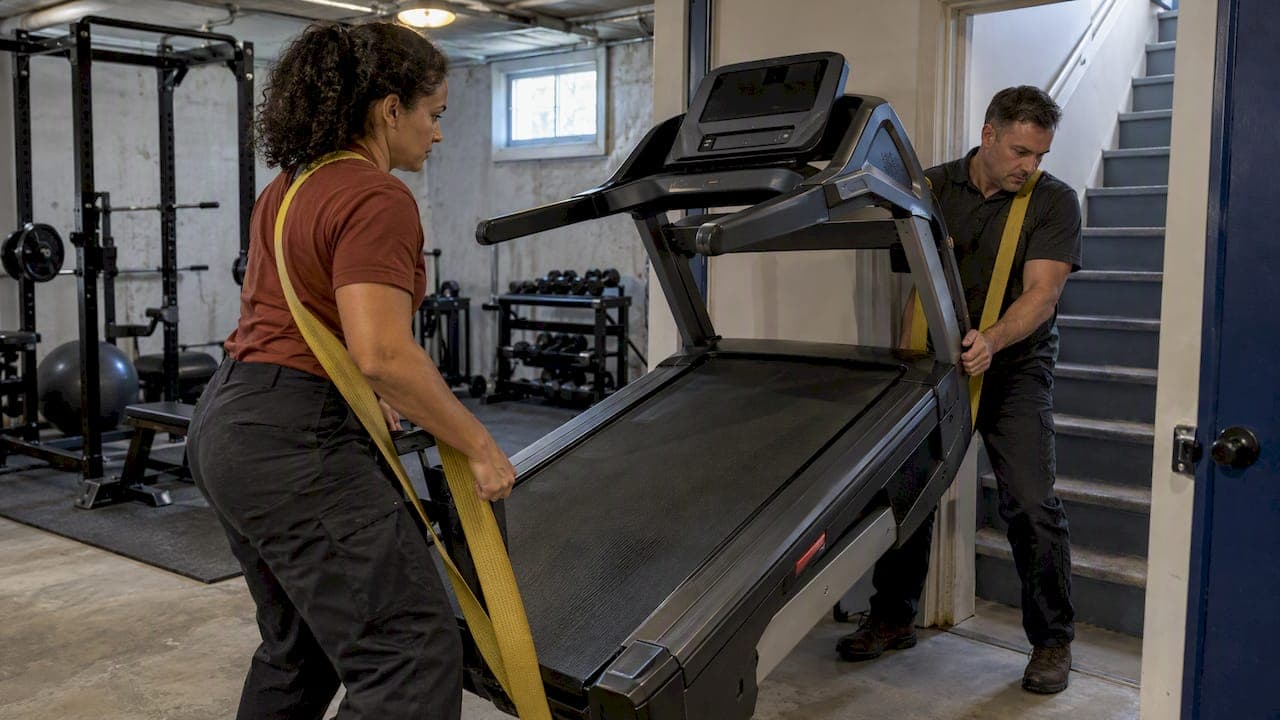
To move gym equipment safely, you need to do three things: shrink each machine (fold it, unbolt it, pull the weights), protect the parts that break easily (consoles, cables, belts), and bring enough people and the right gear to carry it. Most home gym pieces are far heavier than they look. If a move involves stairs, a basement, or a machine you can't lift with a helper, hiring movers is usually cheaper than a damaged machine or an injured back.
This guide covers how to prepare and move treadmills, ellipticals, weight benches, racks and cable machines. It also covers what professional help costs and how to get rid of what you no longer want.
TL;DR
- Read your manual first. Manufacturers say treadmills are heavy and tell you to get help when moving them.
- Fold, unplug, lock and strap moving parts. Remove weight plates, pins and loose accessories before anything is lifted.
- Photograph and label every bolt and cable during disassembly so you can rebuild without guessing.
- Pro help for gym equipment is often quoted by the hour, and published 2026 estimates run $40 to $60 per mover per hour.
- If you're moving in the Capital Region, we can handle the heavy lifting. Request a quote.
Table of Contents
- Plan the move before you touch a machine
- How to move a treadmill
- How to move an elliptical machine
- Moving a home gym: racks, benches, weights and cable machines
- DIY or movers: what the numbers say
- Our perspective: what we see on gym equipment moves
- What to do with equipment you're not taking
- A moving-day checklist for gym equipment
- Getting a moving quote that includes your gym
- Moving gym equipment for a business
- FAQ
- Sources
Plan the move before you touch a machine
The most common mistake is lifting first and measuring later. Spend 20 minutes on planning and you avoid most of the problems.
Measure the route, not just the destination. Check doorways, stairwells, turns, and basement hatches. Treadmill decks, rack uprights and elliptical frames are long and awkward. A machine that came in through a garage door may not fit through an apartment hallway.
Inventory what you own. List every piece with its approximate weight (usually on a label or in the manual), whether it folds, and whether it needs tools to come apart. A full home gym often includes:
- A treadmill, elliptical or bike (heavy, electronic)
- A power rack or cage with a bar and plates
- A bench and adjustable dumbbells
- A cable or multi-station machine (many small parts and cables)
- Mats, which are heavy in bulk and useful as floor protection
Decide what is not worth moving. A 12-year-old machine with a squeaky belt may cost more to move than it is worth. Section after next explains how to sell, donate or recycle.
Gather supplies. You'll want moving blankets, stretch wrap, a socket set and Allen keys, zip ties, painter's tape, sealable bags for hardware, a four-wheel dolly or appliance dolly, and lifting straps. Work gloves and closed-toe shoes are not optional.
How to move a treadmill
Treadmills are the heaviest and most commonly moved piece, and the one that causes the most injuries when people improvise. One manufacturer's owner's manual warns that its treadmills are heavy and says to use care and extra help when moving them. Take that seriously: it comes from the people who built the machine.
Steps for a folding treadmill
- Unplug it and let it sit. Power down, unplug from the wall, and coil the cord. Wind it and tape it to the frame, never loose on the floor.
- Lower the incline fully. Many models should be moved with the incline at its lowest setting. Your manual will say.
- Remove the safety key and any accessories. Take off cup holders, tablets, and mounts.
- Fold the deck according to the manual. Make sure the latch or locking pin is fully engaged before you move it. Never let go of a deck that isn't locked.
- Tilt and roll if it has transport wheels. Tip it back slowly toward you until it rests on its wheels, then roll it. WikiHow's treadmill guide describes this approach for models with wheels, and notes that other models need different handling.
- Use two or more people for stairs. Never carry a treadmill down stairs alone. One person leads from below and one controls from above. Move slowly and call out every step.
If it doesn't fold
Some commercial-style machines don't fold. For those, consult the manual about removing the console mast and motor cover. Do not guess. Take photos at each step and bag the hardware by section. Motor covers hide components that can be damaged by rough handling, and the console cable is often the most fragile part.
Placing it in the truck
Secure the treadmill upright against a wall of the truck with straps through the frame, never the console. Wrap it in a moving blanket and keep the deck from sliding. Don't lay heavy boxes on top of it.
How to move an elliptical machine
Ellipticals look compact but are top-heavy, and the moving arms and pedals can swing and damage walls, door frames or you.
- Check the manual for a disassembly diagram. Most ellipticals come apart into a base, a rear stabilizer, a center column, handlebars and pedal arms.
- Unplug the unit and remove batteries if it has them.
- Take off the console and cables first. Photograph the connections before unplugging. Tape each cable to its matching part.
- Remove the pedal arms and handles, then the center mast if your model allows.
- Bag all hardware and tape the bag to the largest piece so it travels with it.
- Move the base on a dolly. The base is usually the heaviest section. Don't lift it with one person.
If you reassemble, tighten bolts gradually in a cross pattern and check that the machine rests level. A wobble after a move is typically a loose bolt or an uneven floor, not a broken machine.
Moving a home gym: racks, benches, weights and cable machines
Power racks and cages
Racks are heavy steel but easy to disassemble. Remove the J-cups, safeties, pull-up bar and any attachments first, then unbolt the uprights. Label which bolt goes with which hole, because many racks use different bolt lengths. Photograph the assembled rack before you start.
Weight plates, barbells and dumbbells
Weight is the issue here, not size. Move plates in small boxes or sturdy bins, not one huge box that splits. Put the heaviest items in the smallest containers, on the truck floor over the axles when possible. Barbells should be wrapped and kept straight. Adjustable dumbbells should have their handles and plates separated, and be packed in their trays.
Benches and attachments
Adjustable benches can usually be folded or have their back pad removed. Wrap vinyl pads so they don't pick up grease or tears.
Cable machines and multi-stations
These are the most complicated. Cables can kink, pulleys can get lost, and weight stacks need to come off before the frame moves. Take out the pin, remove the stack plates one by one and stack them in order, and secure the guide rods. Take many photos. If your multi-station is large, it is a good candidate for professional help.

Protect your floors
Lay plywood or heavy moving mats on hardwood and stair treads, and use furniture sliders under any base that has to be dragged even a few feet. Rubber gym flooring is heavy in rolls: carry it rolled, with two people.

DIY or movers: what the numbers say
A friend with a pickup truck is the cheapest option in dollars, and sometimes the most expensive in repairs. The question isn't whether you can lift it. It's whether you can lift it safely, through your specific doors and stairs, without damaging the machine or the building.
| Situation | DIY is reasonable | Hire movers |
|---|---|---|
| Ground floor to ground floor, short distance | Yes, with two or more people | Optional |
| One folding treadmill, no stairs | Often | If you're alone or have back issues |
| Basement to second floor, or the reverse | Rarely | Yes |
| Full rack, cable station, plates over a few hundred pounds | Rarely | Yes |
| Apartment with elevator reservation rules | Possible | Helpful for timing and insurance |
| Long-distance move | Not usually | Yes |
On cost, published 2026 estimates put hourly labor for specialized disassembly at roughly $40 to $60 per mover, with local gym equipment moves ranging from about $500 to $2,500 and large long-distance setups reaching $15,000 or more. Those are national ranges from a review site, not a quote from us. Your price depends on weight, number of pieces, stairs and distance.
What you pay for beyond labor is experience. As the same review notes, experienced movers know how to take specialized machines apart and handle heavy components, which protects sensitive electronics and cable systems that amateur moves tend to damage.
Our perspective: what we see on gym equipment moves
We move households and offices across the Capital Region, and gym equipment is one of the items customers worry about most. The worry is usually justified. A treadmill or a rack is the single heaviest thing in many homes, and it often sits in a basement or on a second floor.
Our advice is simple. Tell us about the equipment when you ask for a quote, including the floor it's on, the stairs, and how many machines there are. Surprises are what make moves expensive, and we price from what we know, with no hidden fees. Our crews are trained to handle your belongings with care, and we work seven days a week, including same-day requests, which helps when a lease ends or a closing date moves.
We also see a lot of seniors downsizing from a house with a home gym to an apartment or a smaller place. In those cases, the best move is often to move one machine and let the rest go. We can help with that decision as part of senior relocation assistance, and with cleanouts when equipment needs to leave a property entirely.
— Grandson's
What to do with equipment you're not taking
Not every machine deserves a seat on the truck. Before you pay to move something, consider the alternatives.
Sell or give it away if it works. Working equipment holds resale value, especially racks, adjustable dumbbells and name-brand cardio machines. Offer pickup to buyers only if they bring help.
Donate. Recycling guidance notes that the EPA recommends donating working equipment to community centers or charities. Call first: many charities won't take large machines, and some need to approve photos.
Recycle metal. Broken, metal-based equipment can often go to scrap facilities. Some counties accept it directly. For example, Monroe County's ecopark accepts metal exercise equipment such as treadmills, ellipticals, free weights and exercise bikes in its scrap metal bin, and asks you to remove non-metal parts first. That's a Rochester-area site, so check with your own county or town for the nearest option.
Watch the electronics. Motors and electronic components may be classed as e-waste, so check with your local authorities before putting them in the trash, as the same recycling guide advises.
Have a crew haul it. If you're a landlord, property manager or family clearing a home, a cleanout service saves you from the loading and dump run. See our services.
A moving-day checklist for gym equipment
One week before
- Measure doors, halls and stairs. Compare against machine dimensions.
- Order moving blankets, straps and a dolly, or confirm your movers bring them.
- Decide what you're selling or donating and list it.
The day before
- Disassemble racks, ellipticals and cable machines. Label and bag hardware.
- Remove plates and weight stacks, and box them in small containers.
- Fold and lock treadmills. Wrap cords.
Moving day
- Clear a path and protect floors and doorframes.
- Load the heaviest pieces first, placing them against the cab-side wall.
- Strap everything. Padding between metal parts prevents scratches.
After the move
- Reassemble on a level surface, ideally where you'll use it.
- Check bolts and cable tension before the first workout.
- Test the treadmill belt and display at low speed with the safety key attached.
Getting a moving quote that includes your gym
When you request a quote, give the details a mover needs:
- Each piece of equipment and its approximate weight
- Floors, stairs, elevators and any narrow turns at both ends
- Whether you need disassembly and reassembly or only transport
- Your preferred date, and whether it is flexible
- Anything you want removed rather than moved
A written estimate based on that list is more accurate than a number given over the phone. Our process is based on a quoted estimate, and you can request one here. Gym equipment can be part of a larger household or office move, so there is no need to book separately.
Moving gym equipment for a business
Office buildings, apartment complexes and small studios have their own constraints. Loading docks, freight elevators and building rules about move times all matter. If you manage a property with a fitness room, or you're relocating a company that has one, plan around elevator reservations and certificates of insurance. We handle commercial relocations as well as residential, and our same-day availability helps when a cleanout is urgent. Learn more about what we do on our moving services page.
FAQ
Can I pay someone to move my treadmill?
Yes. Local moving companies will move a treadmill on its own or as part of a larger household move. Tell the company about stairs and whether the machine folds when you ask for a quote, because those two details affect time and crew size more than the distance.
What can I use to move heavy gym equipment?
A four-wheel or appliance dolly, lifting straps, furniture sliders and moving blankets cover most jobs. Take weights off and disassemble racks and ellipticals before moving. Never rely on one person and a hand truck for stairs.
Do I have to disassemble an elliptical to move it?
In most cases, yes, at least partly. Removing the console, pedal arms and handlebars makes it lighter, more compact and less likely to catch a doorway. Check your manual, and photograph every connection before you unplug it.
How do I get rid of gym equipment for free?
Start with donation or giveaway if it still works, since charities and community centers may take it and local buyers will often collect it. For broken metal equipment, try a county scrap metal drop-off. Check local rules for motors and electronics, which may be treated as e-waste.
Is it worth hiring movers for a home gym?
It usually is when you have stairs, a basement, a full rack, or a cable machine. In those cases, damage and injury risks are higher than the labor cost. For one folding treadmill on a ground floor, a capable pair of helpers may be enough.
Sources
- 6 Best Gym Equipment Movers (2026), Today's Homeowner
- Treadmill owner's manual, Johnson Health Tech
- How to Move a Treadmill by Yourself, wikiHow
- How to Dispose of Exercise Equipment: 6 Easy Options
- Scrap Metal, Monroe County ecopark