
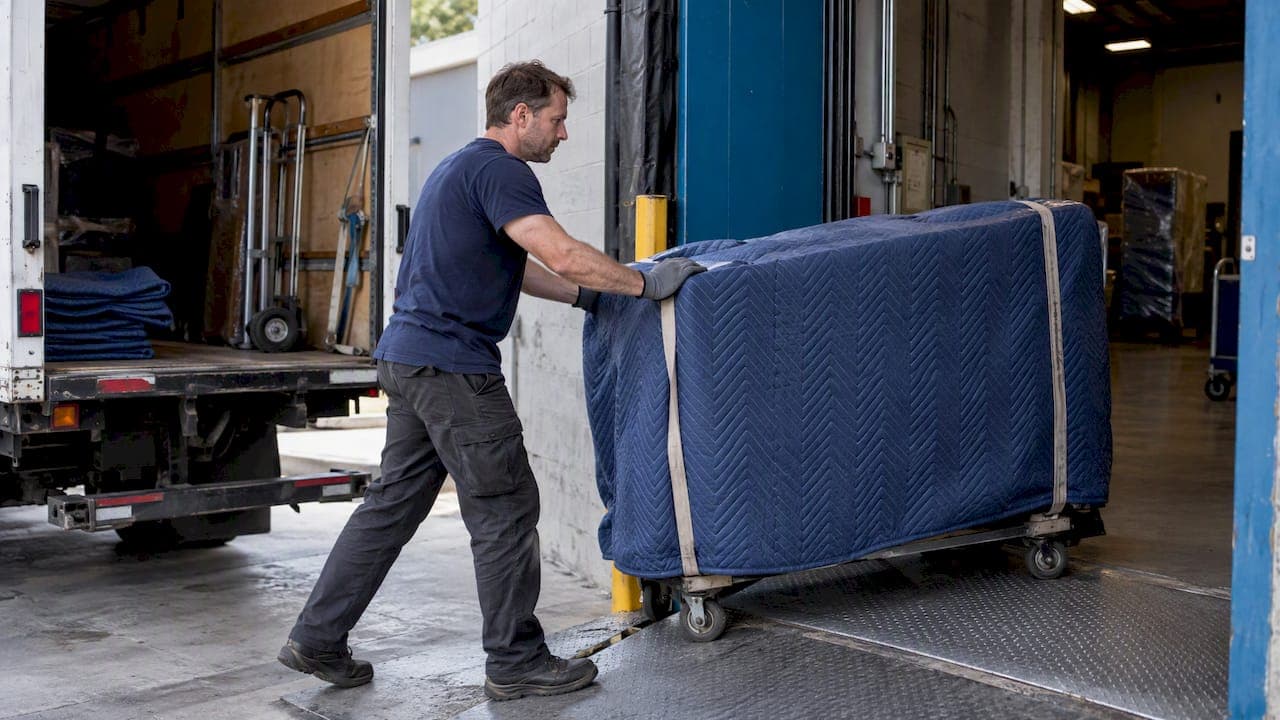
Loading dock scheduling means assigning each truck a specific dock door and arrival window, so freight and people do not pile up at one door at the same time. In a warehouse that is a daily discipline. In an office move, a cleanout or a tenant turnover, it is a single booking that decides whether your move runs on time. This guide covers both sides: how dock scheduling works, how to set it up well, and how to reserve the dock when a moving crew is coming to your building.
TL;DR
- Dock scheduling assigns a door and a time window to every arriving truck. Typical windows run from 30 minutes to 2 hours, depending on staffing and equipment.
- Time is only half of it. The door itself has to suit the load: floor-loaded versus palletized freight, equipment on hand, labor shared with other duties.
- Build in buffer time, keep first come, first served as an overflow valve, and reserve priority slots sparingly.
- For a commercial move, book the dock or freight elevator with building management first, then fix the move date around it.
- A new dock is expensive. Many small operations are better served by smarter scheduling or alternative handling equipment.
Table of Contents
- What loading dock scheduling actually is
- Who needs it, and at what scale
- How a dock appointment works, step by step
- How long should a window be?
- Physical constraints matter as much as the clock
- Scheduling methods that work together
- Track the metric most people skip
- Booking the dock for an office move or cleanout
- What we see from the mover's side
- Safety at the dock
- Do you need a dock at all?
- Common mistakes and how to avoid them
- Planning a move with Grandson's
- FAQ
- Sources
What loading dock scheduling actually is
A loading dock is the point where freight moves between a truck and a building. Scheduling is the system that decides who uses it, when and at which door. The idea is simple: instead of letting trucks arrive whenever they like and wait in line, you give each one a slot.
The Opendock glossary describes it as booking and managing time slots for trucks that load or unload at a facility, usually through software, to replace phone tag and missed appointments. That is the warehouse view. A property manager or office tenant uses the same logic with fewer trucks: one reservation, one door, one window, agreed in writing.
When scheduling breaks down, the problems stack up. First Call Logistics notes that delayed unloading backs up into everything that follows. Drivers wait, crews stand idle, and the next appointment starts late.
Who needs it, and at what scale
Three very different readers land on this topic.
Warehouse and distribution operators. They manage dozens of inbound and outbound trucks a day, often with software and carrier self-scheduling.
Small businesses with a single dock or a shared receiving door. A retailer, a clinic or a light manufacturer may see five deliveries a day. A shared calendar and a few firm rules usually beat any software purchase.
Tenants, property managers and anyone relocating. Your dock is not a daily operation. It is a shared resource you borrow for a morning. Your problem is availability, building rules and timing.
The rest of this guide speaks to all three, with a focus on the second and third, because that is where most Capital Region businesses sit.
How a dock appointment works, step by step
- Request. The carrier, vendor or mover asks for a slot, stating load type, number of pallets or pieces, vehicle size and equipment needed.
- Match. The scheduler checks which door can handle that load and when labor is free.
- Confirm. Both sides receive the door, window and any rules (check-in point, paperwork, insurance).
- Arrive and check in. The truck is logged on arrival so late and early arrivals are visible.
- Load or unload. The crew works inside the window.
- Close out. Actual times are recorded, which feeds the metrics below.
How long should a window be?
There is no universal number. The Infios glossary puts typical windows between 30 minutes and 2 hours, varying with staffing and equipment. Use that as a frame, then size your own:
| Load type | Starting window | What drives it |
|---|---|---|
| Small parcel or van delivery | 30 minutes | One person, hand carry |
| Palletized freight, forklift on site | 45 to 60 minutes | Pallet count, forklift availability |
| Floor-loaded trailer | 90 to 120 minutes | Hand unloading, crew size |
| Office or suite move | Half day to full day | Furniture volume, elevator, number of floors |
The table is our working guide for planning, not a published standard. Treat the first month as a test and adjust from your actual times.
Physical constraints matter as much as the clock
The most common mistake is to treat dock scheduling as a calendar problem. A C3 Solutions white paper argues that good scheduling starts with a profile of the facility: what each door can physically handle, which equipment is required, and whether the people who load are also doing other jobs. Only then should outsiders be asked to pick slots.

The same paper makes a point that applies to every size of operation: ignoring physical requirements, such as whether a door suits a floor-loaded or a palletized load, creates bottlenecks no software can fix on the day.
For a move, translate that into questions:
- Is there a dock height door, or only a street-level entrance?
- What is the freight elevator's size and weight rating, and can it be reserved?
- How far is the dock from the suite, and are there doors, ramps or corners to plan around?
- Where can a full-size truck legally and safely park if the dock is taken?
Scheduling methods that work together
No single method covers every case. First Call Logistics finds the best results usually come from combining approaches:
- Buffer time between appointments absorbs late arrivals so one delay does not cascade.
- First come, first served works best as a relief valve when overflow hits, not as the main system.
- Triage scheduling gives priority to urgent or expedited shipments. Use it selectively, or carriers will feel the friction.
A practical setup for a small facility: fixed appointments for the predictable majority, a 15 to 30 minute buffer after any long slot, and one open window a day for walk-ins and emergencies.
Track the metric most people skip
Wait time is the obvious number. The Opendock glossary also points to the reschedule rate. When it is high, your rules may be too rigid for real traffic, or communication with carriers is failing. Use it to adjust buffers and window lengths rather than simply penalizing late arrivals.
For a building that hosts moves, the same idea applies. If movers and tenants keep asking to change their slots, your booking window is probably too narrow or your notice rules too strict.
Booking the dock for an office move or cleanout
This is where a calendar becomes a project. Here is the order we recommend for a commercial move in an Albany-area building.
- Call building management first. Ask about dock hours, freight elevator reservations, blackout dates, and whether moves are allowed on weekends or only after business hours.
- Ask for written requirements. Many buildings set insurance, protection and timing rules. Get them in writing before you pick a date.
- Reserve the dock and elevator together. A dock slot with no elevator, or the reverse, only moves the bottleneck.
- Share the details with your mover. Dock location, loading height, elevator size, access hours and any parking restrictions.
- Plan a buffer. Build in an extra hour at the start or end. A late-arriving crew or a stuck elevator should not push you past your reservation.
- Confirm 48 hours ahead. Reconfirm the dock, the elevator operator and the contact on site.
Property managers handling cleanouts follow the same logic in reverse: schedule the dock before the crew, so debris and furniture have a defined path out and the next turnover is not delayed.
What we see from the mover's side
Most delays on a commercial move are not about the truck or the crew. They come from a dock window nobody confirmed or an elevator nobody reserved. We ask for the building's dock rules before we ever name a date, and we plan the crew's day around the reservation, not the other way around.
Quoting is easier when the building details arrive early. A dock down the hall and a freight elevator the size of a closet change the number of crew members and hours a move needs, and we would rather price that honestly up front than surprise anyone later. That is why our pricing stays transparent, with no hidden fees.
When a plan changes, we want to hear it early. We work seven days a week and accept same-day requests, so a rescheduled dock slot does not have to mean a lost week.
— Grandson's
Safety at the dock
The dock is one of the riskier parts of any building. The National Safety Council reports, citing Bureau of Labor Statistics data, that 84 workers died in incidents involving forklifts and other powered industrial trucks in 2024. It also notes that simple lapses, such as not confirming dock plates are secure or skipping daily equipment inspections, often precede serious crushing incidents.
Schedule with that in mind:
- Keep pedestrians and vehicles separate. Do not book a slot that forces a move crew to carry furniture across an active forklift lane.
- Stagger arrivals so two trucks are not working the same apron at once.
- Leave time for the check-in routine: securing the trailer, checking the plate and walking the path.
- Give every new crew member or visiting driver the site rules before the first load.
If you operate powered industrial trucks, OSHA's rules on operator training apply. Your safety manager or an OSHA-qualified consultant should confirm your site's specific requirements. OSHA has said that effective operator training and strong safety management systems are critical to preventing injuries.
Do you need a dock at all?
Sometimes the right answer to a scheduling problem is to stop scheduling a dock you cannot afford to build.
A 2025 cost guide from Begley Overhead Doors says a new bay typically starts around $20,000, and retrofitting an existing pit costs $10,000 or more per bay. Preventive maintenance contracts generally run $400 to $650 a year per bay. Multi-dock projects with site prep, levelers and structural work can pass $100,000. Superior Handling Equipment likewise says a traditional dock with excavation, concrete, leveler, supports and permitting can cost over $100,000.

That firm also argues that many businesses only need a safe way to move product between the ground and a box truck, and that portable lifts or ramps can deliver the throughput without the capital cost. Both are sellers of dock equipment, so treat the figures as ranges and get local quotes before budgeting.
For a company that moves offices once every few years, a permanent dock is almost never the answer. A well-planned reservation in a building that already has one is.
Common mistakes and how to avoid them
| Mistake | Fix |
|---|---|
| Booking a time without checking the door's capability | Match load type to door and equipment first |
| No buffer between appointments | Add 15 to 30 minutes after long slots |
| Priority slots for everyone | Reserve triage for truly urgent loads |
| Reserving dock but not elevator | Book both in one call |
| Never reviewing actuals | Record real start and end times, check reschedule rate monthly |
| Changing the date after booking the mover | Confirm the dock before fixing the move date |
Planning a move with Grandson's
If your next relocation involves a shared dock, a freight elevator or a tight building window, we can plan around it. Grandson's Moving Company handles local and long-distance moves for homes and businesses across the Capital Region, along with professional packing, senior relocation assistance and cleanouts for property managers. Send us the building's dock details and your preferred date through our quote page, and we will build the day around your reservation.
FAQ
What is the difference between dock scheduling and yard management?
Dock scheduling assigns door and time slots to trucks that are arriving. Yard management tracks trucks and trailers once they are on the property, including parking and gate movements. Small operations usually need only the first.
How far ahead should I reserve a dock for a commercial move?
As soon as your date is realistic, and before you commit to a mover's calendar. Buildings differ in their notice rules, so ask management for the minimum lead time and for blackout dates. Confirm again 48 hours before the move.
What should I do if the dock is unavailable on my move day?
Ask management for an alternate window, such as an early morning or weekend slot, and tell your mover immediately. Same-day or next-day changes are far easier to absorb if the crew hears early. We accept same-day requests, so call us as soon as plans change.
Do I need dock scheduling software?
Not at low volume. A shared calendar, written rules and a buffer are enough for a handful of deliveries a day. Software starts to earn its cost when many carriers book into many doors and phone coordination takes up real staff time.
How much does it cost to build a loading dock?
Published 2025 estimates put a new bay at about $20,000 and up, and a retrofit at $10,000 or more per bay, with large projects exceeding $100,000. Your site, permits and equipment will change the number, so get local bids.
Sources
- Dock appointment scheduling, Infios glossary
- Logistics glossary, Opendock and ShipperGuide
- Improving dock efficiency, First Call Logistics
- Understanding dock scheduling white paper, C3 Solutions
- Work safety: forklifts, National Safety Council Injury Facts
- National Forklift Safety Day remarks, OSHA
- 2025 loading dock cost breakdown, Begley Overhead Doors
- You don't need a loading dock, Superior Handling Equipment