
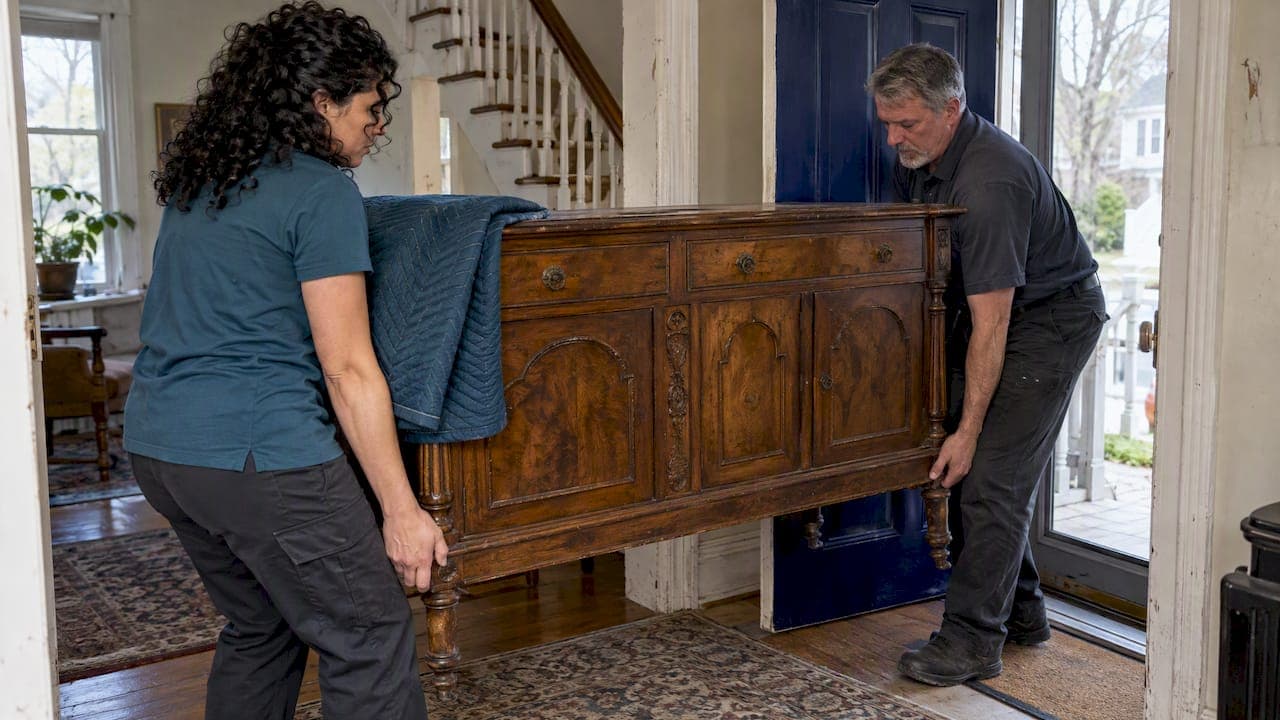
Moving antique furniture safely comes down to four things: knowing the condition of each piece before it moves, wrapping it with soft materials, lifting it by its structure instead of its decoration, and getting the mover's liability coverage in writing before the truck is loaded. A trained crew handles most of that for you. What follows is how the work is done properly, what it costs, and what to ask whoever you hire. We are Grandson's Moving Company, and we move households and businesses across the Capital Region, so we have written this with an Albany-area move in mind.
TL;DR
- The biggest risk to an antique is repeated handling and poor planning, not the drive itself. Fewer lifts and a mapped route protect a piece more than anything else.
- Photograph every piece from several angles, note existing damage, and check joints, veneer and drawers before anything is wrapped.
- Use soft cotton straps and moving blankets on antique finishes. Never put packing tape on them.
- Ask your mover for its valuation options in writing. Basic released-value coverage pays only 60 cents per pound per article on interstate moves.
- Tell the mover about the antiques when you ask for a quote, so the crew, the equipment and the timing match the job.
Table of Contents
- What counts as antique furniture, and why it moves differently
- Where the real risk is
- Before moving day: prepare each piece
- How the piece should be wrapped and carried
- What antique moving costs
- Insurance and valuation: read this before you sign
- Perspective: how we approach antique pieces
- Choosing a mover for antiques: what to ask
- Should you move antiques yourself?
- Moving antiques with Grandson's
- FAQ
- Sources
What counts as antique furniture, and why it moves differently
People searching this topic often ask about the "100 year rule." It is a common shorthand for what dealers call an antique, but a mover does not care about the label. What matters is how the piece was built. Antique furniture is usually held together by hide glue, wooden pegs and hand-cut joints, not by screws and modern adhesives. Its finish may be shellac or old varnish that marks easily. Its veneer can be lifting at the edges. Decorative carving, spindles and brass pulls are often the weakest points on the whole piece.
That is why a dresser that survives forty years of ordinary use can still come apart when someone lifts it by a drawer pull. Museum guidance on wooden objects is blunt about it: always lift using the lowest horizontal structural support, never by handles, arms or decorative projections.
It also explains why "treat it like regular furniture, just slower" is not enough. The right method differs piece by piece, and the plan has to be made before anyone picks anything up.
Where the real risk is
Most people picture a bumpy truck ride wrecking a grandfather clock or a secretary desk. Conservators see it differently.
Guidance for cultural collections stresses that objects are at their most vulnerable when being moved, and that the damage comes from repeated handling and poor planning. Every extra lift is another chance for a knock, a slip or a strain on an old joint. A good move therefore reduces the number of times a piece is picked up, and decides ahead of time where it will be set down.
Vibration matters less than you might think. Smithsonian research on shipping art notes that well-packed, sound objects tolerate vibration reasonably well, while sharp swings in temperature and humidity are the bigger threat to wood and finishes. For a move around Albany, Schenectady or Troy, that has a practical meaning. In January, a piece should not sit on a cold driveway or in an unheated truck for hours. In August, it should not bake in a closed trailer. Schedule the loading and unloading so the furniture spends as little time outdoors as possible.
Before moving day: prepare each piece
Preparation is where you can do the most good yourself, and where a mover can do the most with good information from you.
Document everything
Standard practice is to build an inventory with high-resolution photos taken from multiple angles, including any existing damage. Do it in daylight. Photograph the top, the back, the underside, the drawer interiors and any maker's marks or labels. Close-ups of chips, scratches, water rings and old repairs matter most, because they settle any later argument about what was damaged in transit and what was already there.
If a piece has real monetary value, get a current appraisal. It supports your insurance or valuation choice, and it tells you whether a piece deserves extra protection.
Check structural condition
Before packing, look for loose joints, splits, wobbly legs and lifting veneer. Canada's conservation institute advises to check furniture for damage or loose joints before moving it, then remove surface objects and take out drawers, shelves and doors where they come out. A chair with a loose rung should be flagged to your mover so the crew carries it instead of sliding it.
Secure what cannot be removed
The same guidance says elements that cannot be removed should be secured with soft cloth (cotton) straps. Cotton twill tape is the usual choice. Use it to keep doors closed and drawers in place. Do not use packing tape or masking tape on an antique finish, because adhesive can lift old varnish and shellac and leave marks that need a restorer to fix.

Measure the route
Museum standards call for planning every step before lifting, including mapping the route and measuring doorways, and confirming the destination is clear. In the Capital Region that matters. Many homes in Albany's Center Square, Troy's historic districts and Saratoga Springs have narrow stairwells, tight turns and older entries. A tall breakfront or a four-poster bed that fits in on the first try is the exception.
Measure the piece at its widest and tallest. Measure every doorway, stair landing and hallway it has to pass through. Tell your mover about anything tight. Sometimes a piece has to come apart, and that decision is better made at the quote stage than on the stairs.

How the piece should be wrapped and carried
Here is the sequence a careful crew follows.
- Clear the route. Move rugs, shoes, plants and doormats. Prop doors open. Put down floor protection at the entry and on the stairs.
- Remove loose parts. Take out drawers, shelves and glass, and wrap them separately. Remove mirrors from dressers and wrap them flat in padding.
- Pad the piece. Cover the whole piece with clean moving blankets, then secure the blankets with stretch wrap only over the blanket, never touching the wood. Pad corners, feet, carved edges and anything that projects.
- Lift from the frame. Two or more people carry the piece by the lowest structural supports. Nobody lifts by the arms, a top rail, pulls or finials. Use a dolly for heavy or awkward items, with padding between the piece and the dolly.
- Keep it upright and in its normal orientation. Tall cabinets and clocks stay upright. Tables go top down on padding only if the base is removed or built for it, and a crew should decide that case by case.
- Load it so nothing can shift. Antiques ride against the truck wall or other padded furniture, strapped in and never beneath heavy items or stacked loose boxes.
- Unload to a planned spot. The destination is marked in advance so the piece is set down once.
Special cases
Marble tops. Remove the marble top from its base and carry it vertically. Large marble tops can fracture under their own weight if supported horizontally. Wrap it in thick padding and move it on its edge.
Glass-front cabinets and curio cabinets. Take out the shelves and the glass if it is removable. If it is not, pad the glass and tell the crew where it is fragile.
Clocks and pianos. Grandfather clocks need weights, pendulums and the movement handled according to the maker or a clock specialist. Pianos are a separate discipline and should be treated as such. Tell any mover about them in advance, because they affect crew size and equipment.
Upholstered pieces. Fabric needs a clean cover, not plastic held tight against it for days, which can trap moisture.
Keep wood away from heat and sun
At the new home, do not park a wooden antique next to a radiator, a heating vent or a sunny window just because that is where the movers had room. Conservation guidance says to avoid placing wooden antiques near heat sources or in direct sunlight. After a winter move, let a piece settle in the house for a while before you load drawers or stack things on top.
What antique moving costs
Movers price antique work differently, and no honest guide can give you one number. Local moves in our area are generally priced on crew size, time, and the complexity of the job. Long-distance moves are priced on weight and distance. Antiques add labor for wrapping, disassembly and slower handling, and may call for extra crew.
For a sense of scale on long-distance moves, one consumer guide reports that specialty antique handling adds roughly $50 to $1,000 or more to a shipment, on top of an average long-distance cost of $3,124 as of 2026. The spread is wide because it depends on how many pieces you have and how much custom packing each needs.
What drives the price on your move:
| Factor | Why it matters |
|---|---|
| Number and size of pieces | More pieces mean more wrapping time and more careful loading |
| Disassembly | Beds, tables and tall cabinets may need to come apart and go back together |
| Stairs and access | Third-floor walk-ups and narrow turns add labor |
| Packing materials | Custom padding, crating or wrapping for fragile items |
| Distance | Local hourly work versus long-distance weight-based pricing |
| Valuation coverage | Higher protection levels can cost more |
The best way to keep the quote accurate is to give the mover a full list with photos. Surprises on moving day are usually the result of a quote built on incomplete information.
Insurance and valuation: read this before you sign
This is the part people skip, and the part that matters most if something goes wrong.
Movers do not sell insurance in the usual sense. They offer valuation coverage, which sets the limit of their liability. Under federal law, interstate movers must offer two options, Full Value Protection and Released Value. Released Value costs nothing extra, but the mover is responsible for no more than 60 cents per pound per article. The FMCSA's own example is a 25-pound TV that would return only $15. Now think about a 150-pound oak sideboard worth several thousand dollars. Under basic coverage, the payout could be about $90.
Federal guidance also warns against failing to notify your mover in writing about articles of extraordinary value. If you own a piece that is worth much more than its weight suggests, say so on paper.
Documentation carries legal weight too. Commentary on the Carmack Amendment notes that federal appellate courts have voided liability limits when a mover failed to provide required paperwork, such as the rights-and-responsibilities booklet or a completed valuation section on the bill of lading. That is a lawyer's reading of the case law, not a reason to skip the paperwork yourself. Read the valuation section, choose a level deliberately, and keep your copy.
If you are moving a high-value piece, talk with your homeowner's or renter's insurer about a scheduled item rider or a fine-arts policy. Those policies are written separately from mover coverage. For a move entirely within New York State, rules and limits can differ from the federal interstate rules above, so ask your mover to explain exactly what applies to your move and put it in writing.
Perspective: how we approach antique pieces
We are a family-style local mover, and our crews are trained to treat each client's belongings with care and efficiency. Antiques are where that training shows. Here is how we think about them.
First, we believe the quote should describe the job. When a customer tells us there is a Victorian sideboard, a pair of marble-top nightstands and a tall case clock, we can plan crew size and materials before moving day. When we only find out about them at the door, everybody loses time, and the piece pays the price. So we ask early and we ask for photos.
Second, we price transparently, with no hidden fees. For delicate work that matters even more, because people are already nervous about the move. You should know what the plan is and what it costs before the first blanket comes off the truck.
Third, we think accountability is the real test of a mover. If something goes wrong, you should be dealing with people who answer the phone, look at the photos you took and make it right through the process their paperwork describes. That is also why we tell customers to document everything, because clear records protect both sides.
Finally, because we work seven days a week and accept same-day requests, we can often fit a move around the weather and the building schedule. For antiques, that flexibility is useful. A dry day beats a wet one.
— Grandson's
Choosing a mover for antiques: what to ask
Whether you hire us or someone else, use this list. A good mover answers these without hesitation.
- Have you moved pieces like mine? Ask about specific furniture types: tall case clocks, marble tops, glass cabinets.
- Who will be on the crew, and are they trained? Antique work depends on people, not trucks.
- How will you wrap and secure my pieces? Listen for blankets, soft straps and padding, not packing tape on wood.
- What valuation options do I have, and what do they cost? Get it in writing, and ask what the payout would be for your most valuable piece.
- Is the quote binding or an estimate, and what could change it? Ask what causes extra charges.
- What will you do if a piece cannot fit through a door? The answer shows planning.
- How do you handle weather? Cold, heat and rain all affect wood.
Be cautious with any mover who quotes a price over the phone without asking about stairs, item count or access, or who pushes you to accept the minimum coverage without explaining it. The FMCSA warns about common moving fraud schemes, and the first step in a dispute is to try resolving it with the company or broker and check what coverage you have.
Should you move antiques yourself?
Sometimes yes. A small side table, a framed mirror or a chair can go in your own vehicle if you wrap it well and take your time. Do it yourself when the piece is light enough for one person to carry without strain, when you can get it from room to room without tight turns, and when its value is mostly sentimental and you accept the risk.
Hire professionals when a piece is heavy, tall, fragile or valuable, when stairs are involved, or when it has to be disassembled. If you pack boxes of china or glass yourself, note that damage to articles you packed can be harder to claim for. A mover who packs an item takes responsibility for how it was packed.
Moving antiques with Grandson's
If you are planning a move in Albany, Schenectady, Troy or the surrounding Capital Region, we can handle your antiques as part of a full local or long-distance move, with professional packing if you want it. See the full range on our moving services page, then request a quote. Mention your antique pieces, send photos and measurements, and tell us about stairs and access. We will plan the crew around the actual job. Our pricing is transparent with no hidden fees, and we take same-day requests when our schedule allows.
Seniors downsizing from a family home often have the most heirlooms and the most decisions to make. Our senior relocation assistance is built for that situation, and our guide to a smooth move is a good place to start planning the rest.
FAQ
How do I move antique furniture safely?
Document each piece with photos, check the joints, remove drawers and shelves, and secure doors with cotton straps. Wrap the piece in moving blankets, carry it by its lowest structural supports, and plan the route before anyone lifts. For heavy, tall or valuable pieces, hire trained movers.
Can I use bubble wrap or packing tape on antiques?
Never put tape directly on an antique finish, since adhesive can damage old varnish and shellac. Bubble wrap against bare wood is also a poor idea, because it can leave an impression on a soft finish. Use a clean cotton or moving blanket first, then add outer protection.
Does my mover's coverage pay what my antique is worth?
Not automatically. On interstate moves, the free Released Value option covers only 60 cents per pound per article. Full Value Protection costs more but covers actual loss or damage. Ask for your options in writing and tell the mover about any item of extraordinary value.
How much does it cost to move antique furniture?
It depends on the number of pieces, disassembly, stairs and distance. One consumer guide puts specialty antique handling at $50 to $1,000 or more on top of a standard long-distance move. For a local move, the best way to get a firm number is to send your mover a list with photos.
Is cold weather a problem for antique furniture?
It can be. Extreme swings in temperature and humidity are a bigger threat to wood than vibration. Keep pieces from sitting outside or in an unheated truck for long, and keep them away from radiators and vents once they are in the new home.
Sources
- Appendix N: Curatorial Care of Wooden Objects (National Park Service)
- Conserve O Gram 7/7: Emergency Treatment for Water-Soaked Furniture and Wooden Objects (National Park Service)
- Handling, Packing and Transport (Museums and Heritage Advisor)
- Art in Transit (Smithsonian Institution)
- Basic care: furniture and objects made of wood (Canadian Conservation Institute)
- Liability and Protection (FMCSA)
- Common Moving Fraud Schemes (FMCSA)
- The Carmack Amendment Explained for Movers (Elromco)
- Best Antique Moving Companies (This Old House)